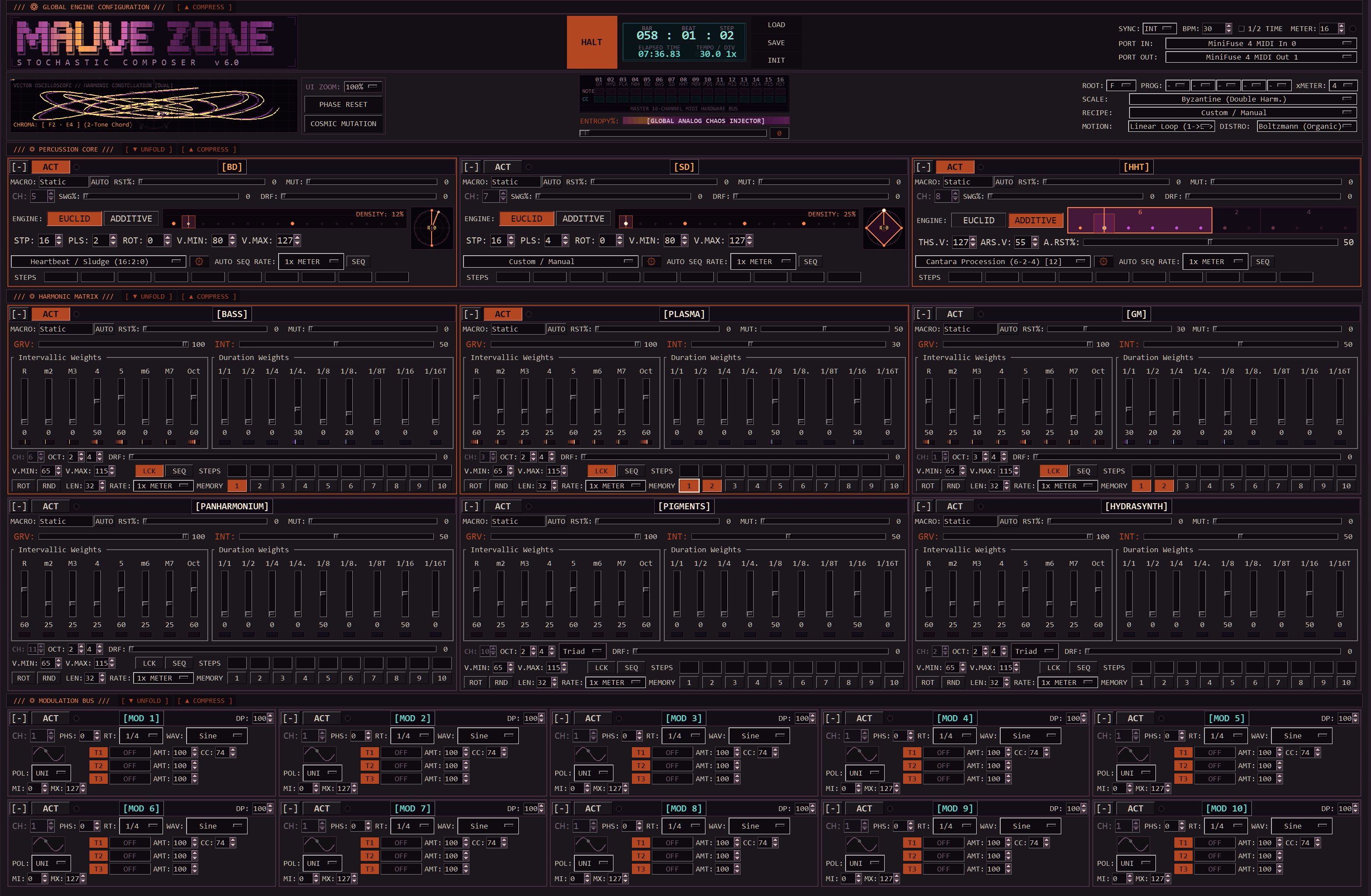
User Guide & Technical Reference
01 // Overview
Mauve Zone Stochastic Composer is a 16-channel generative MIDI sequencer for hardware synthesizers and DAWs. Instead of fixed step patterns, it uses probability distributions, rolling Turing buffers, and Euclidean/Aksak rhythm generators to build evolving phrases in real time.
02 // Quick Start
python mauve_zone_stochastic_composer_v6.0.py in your terminal.
03 // Stochastic Architecture
Following the formalized stochastic composition methods of Iannis Xenakis (Formalized Music), you define pitch boundaries and statistical weights while the engine evaluates micro-events step by step.
Probability Distributions (DISTRO)
Boltzmann favors stepwise continuity; Gaussian pulls pitches toward the root; Cauchy permits wide, heavy-tailed interval jumps.
Markov Sluggishness & Stamina (STA%)
1st-order Markov fatigue accumulates tension during dense runs—dragging note gates longer—and resets during rests.
Turing Memory Buffers (LCK / M1–M10)
Each channel stores its recent output in a 384-step rolling history buffer. Engaging LCK freezes the current phrase into a repeating loop.
Euclidean & Additive Rhythms
Euclidean (Bjorklund) distributes pulses evenly across arbitrary step lengths; Additive (Aksak) chains 2- and 3-step cells into odd meters (5/8, 7/8, 9/8).
04 // Global Engine Controls
| Subsystem | Parameters | Function |
|---|---|---|
| Master Transport | ENGAGE / HALT, Phase Reset | Starts or stops the MIDI clock loop and phase counters. |
| Counter Display | Bar : Beat : Step | Tracks phrase position and elapsed runtime. |
| 16-Ch Meter Bridge | Note-On / CC Activity | Real-time trigger (amber/green) and CC (cyan) monitors across all 16 MIDI channels. |
| Vector Scope | Waveform / Lissajous / Constellation | Visualizes pitch constellations and polyphonic intervals. |
| Clock & Sync | INT / EXT, BPM, 1/2 TIME | Internal hybrid spin-lock clock or external MIDI Realtime Clock (F8) sync. |
| Harmonic Constraints | ROOT, SCALE, PROG | Base key, scale filter, and chord progression with shortest-path voice leading. |
| Entropy & Mutation | ENTROPY %, Randomize | Micro-timing jitter and parameter randomization. |
05 // Channel Modules & Modulation Bus
Harmonic Matrix Channels
Macros (Static, Octave Drop, Pedal Point, Echo), Rest % (RST%), Mutation % (MUT%), Gravity (GRV%), octave limits (MIN/MAX), chord voicings (Triad, 7th, Sus4, Add9, Open 5th), and 10 recall slots (M1–M10) with auto-rotation.
Euclidean & Additive Drums
Bjorklund Euclidean distribution, Aksak additive cells, swing timing (SWG%), Gaussian timing drift (DRF), and step chasers.
Clock-Synced LFO Bus
Clock-locked LFOs (Sine, Triangle, Saw, Pulse, Random, SlewRand, S&H, Chaos) with unipolar/bipolar scaling, 0°–360° phase offset, and routing to internal controls or MIDI CC.
06 // Threading & Timing Architecture
-
Hybrid Spin-Lock Timing: Uses
time.perf_counter()with shorttime.sleep(0)yields below 2 ms for tight MIDI clock stability independent of GUI redraws. - Write-Through Rolling Buffers: Captures 384 steps per channel including sustained notes crossing bar boundaries without hung gates.
-
Atomic FIFO Queues: Background MIDI threads push telemetry to Tkinter via
collections.dequequeues to keep the interface responsive under heavy density.