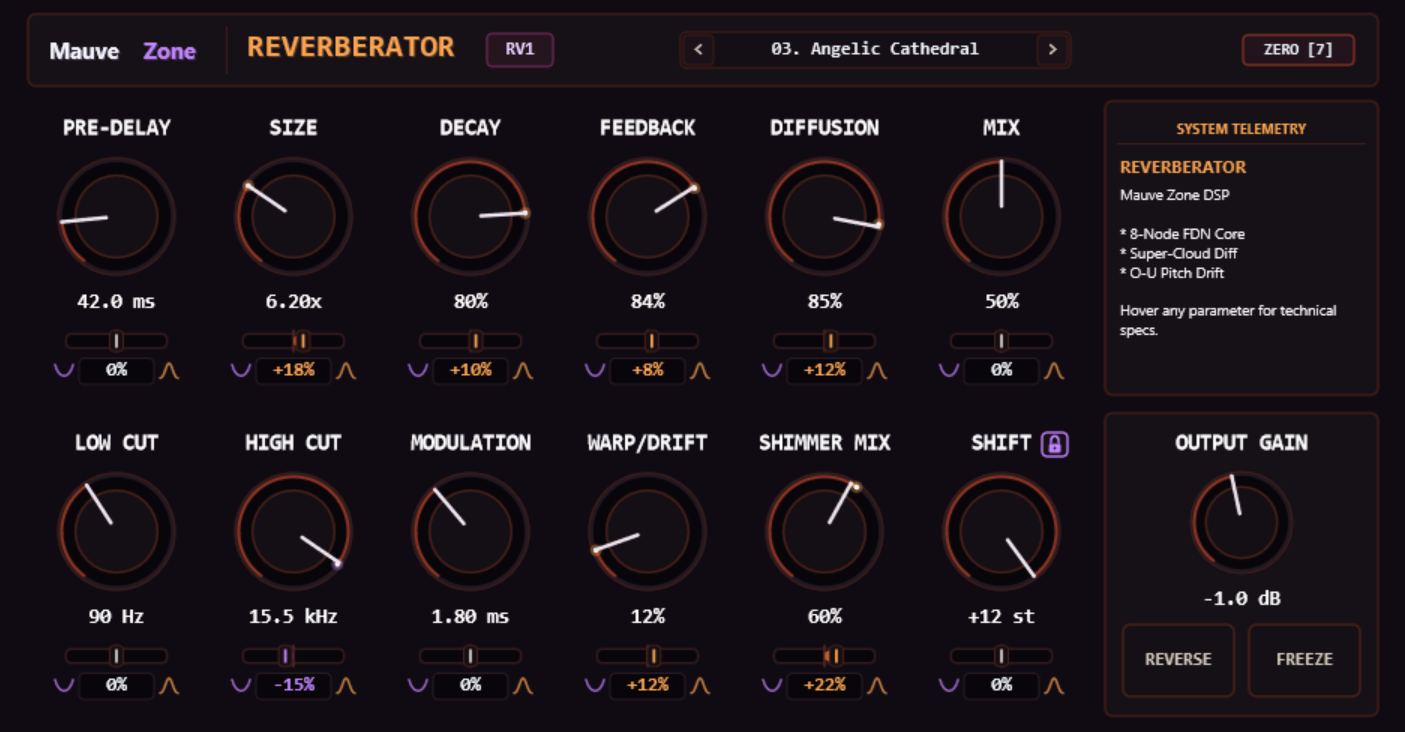
User Guide & Technical Reference
01 // Reverb Architecture Lineage
Acoustic reverberation is a dense statistical field of reflections where air and room surfaces absorb high frequencies faster than lows. Reverberator-RV1 pairs Feedback Delay Network (FDN) acoustics with non-linear tape drive and stochastic modulation.
| ERA | INNOVATOR | ARCHITECTURAL BREAKTHROUGH |
|---|---|---|
| 1962 | Manfred Schroeder (Bell Labs) | First digital reverb using comb and all-pass filters; proved digital space was viable though prone to metallic ringing. |
| 1978 | David Griesinger (Lexicon 224 & 480L) | Recirculating figure-8 delay tanks with input diffusers for smooth, musical decay tails. |
| 1984 | Brian Eno & Daniel Lanois | Routed harmonizer pitch shifts (+12 semitones) inside reverb feedback loops, establishing shimmer reverb. |
| 1991 | Jean-Marc Jot (IRCAM, Paris) | Formalized the Feedback Delay Network (FDN), coupling prime delay lines via unitary matrices for exponential echo growth. |
| 2026 | Mauve Zone — Reverberator RV1 | 8-node Hadamard FDN, 4-stage Golden Ratio diffusers, anti-aliased tape drive, and Ornstein-Uhlenbeck thermal drift. |
02 // Signal Path
RV1 synthesizes reflections in real time rather than using static convolution impulse responses:
                          [ STEREO INPUT (L/R) ]
                                    |
                         +--------------------+
                         |     PRE-DELAY      | (0 to 500 ms)
                         +--------------------+
                                    |
                  +----------------------------------+
                  |  4-STAGE GOLDEN RATIO DIFFUSER   | (Anti-Flutter Smear)
                  +----------------------------------+
                                    |
                    +---------------+---------------+
                    |                               |
                    v                               v
           [ SHIMMER ENGINE ] <------------+  [ 8-NODE FDN TANK ]
           (Dual-Grain Pitch)              |  (Fast Walsh-Hadamard)
                    |                      |        |
                    v                      |        v
           [ SHIMMER MIX ] ----------------+  [ IN-LOOP ALL-PASSES ]
                                                    |
                                              [ AIR DAMPING ]
                                              (Low Cut / High Cut)
                                                    |
                                              [ MAUVEDRIVE SAT ]
                                              (ADAA Tape & Power Sag)
                                                    |
                                                    v
                                          [ STEREO TAP MATRIX ]
                                                    |
                                          [ DRY / WET BLEND ]
                                                    |
                                          [ STEREO OUTPUT (L/R) ]
03 // DSP Design
3.1 4-Stage Input Diffusers: Four cascaded all-pass diffusers tuned to the Golden Ratio (0.618) smear sharp transients before they hit the tank, preventing flutter echoes on percussive material.
3.2 8-Node Walsh-Hadamard FDN: Eight mutually prime delay lines (24 ms to 90 ms base lengths) coupled via an 8×8 Fast Walsh-Hadamard Transform multiply echo density by 8 per pass with low CPU overhead.
3.3 MauveDrive Saturation & 95 Hz Resonance: Anti-derivative anti-aliasing (ADAA) soft saturation sits inside the loop alongside a 95 Hz transformer resonance boost and dynamic power-rail sag.
3.4 Crystalline Pitch Shifter & Padlock: Dual-grain shimmer engine with raised-cosine windowing. The Padlock toggles between free microtonal glide and chromatic semitone snapping.
3.5 Stochastic Drift: Twelve bipolar attenurandomizers use an Ornstein-Uhlenbeck process (mean-reverting Brownian drift) to break up static modal ringing without cyclic LFO predictability.
3.6 Feedback / Decay Balance: Pushing Feedback above 100% saturates the internal drive while lowering Decay clamps each loop pass, letting you surf hot tape compression without runaway clipping.
3.7 Dual-Path Stereo Topography: Left and Right channels run through independent 8-node FDN engines with asymmetric prime diffusers for wide stereo imaging and clean mono summing.
04 // Parameter Reference
| CONTROL | RANGE | FUNCTION |
|---|---|---|
| PRE-DELAY | 0.0ms – 500.0ms | Gap before reflections begin, separating dry transients from the reverb tail. |
| SIZE | 0.20x – 2.00x | Scales all 8 delay lines simultaneously from tight room to large hall. |
| DECAY | 0.10s – 20.00s | RT60 decay time; acts as loop attenuation against Feedback. |
| FEEDBACK | 0.0% – 120.0% | Recirculation intensity. 0–50% clean; 50–100% bloom; 100–120% saturated self-oscillation. |
| DIFFUSION | 0.0% – 100.0% | Phase dispersion from discrete multi-tap repeats to smooth wash. |
| MIX | 0.0% – 100.0% | Equal-power dry/wet blend. |
| LOW CUT | 20.0Hz – 500.0Hz | In-loop high-pass filter to control low-end buildup. |
| HIGH CUT | 1.0kHz – 20.0kHz | In-loop low-pass filter modeling high-frequency air damping. |
| MOD | 0.0% – 100.0% | Cubic Hermite delay-tap modulation depth. |
| WARP | 0.0% – 100.0% | ADAA tape saturation, 95 Hz transformer resonance, and rail sag. |
| SHIMMER MIX | 0.0% – 100.0% | Level of the pitch-shifted signal fed into the reverb loop. |
| SHIMMER PITCH | -24.0st – +24.0st | Shimmer interval; Padlock switches semitone snap vs. continuous glide. |
| [ ZERO RND ] | Momentary Button | Resets all 12 attenurandomizers back to 0%. |
05 // Sound Design Archetypes
06 // Engineering Notes
- Zero Audio-Thread Allocations: Buffers, delay lines, and saturators are pre-allocated at initialization for dropout-free real-time execution.
- Denormal Protection: Hardware FTZ/DAZ flushing eliminates CPU spikes as reverb tails decay toward zero.
- Calibration: 1% mouse-wheel fine resolution across all front-panel controls.