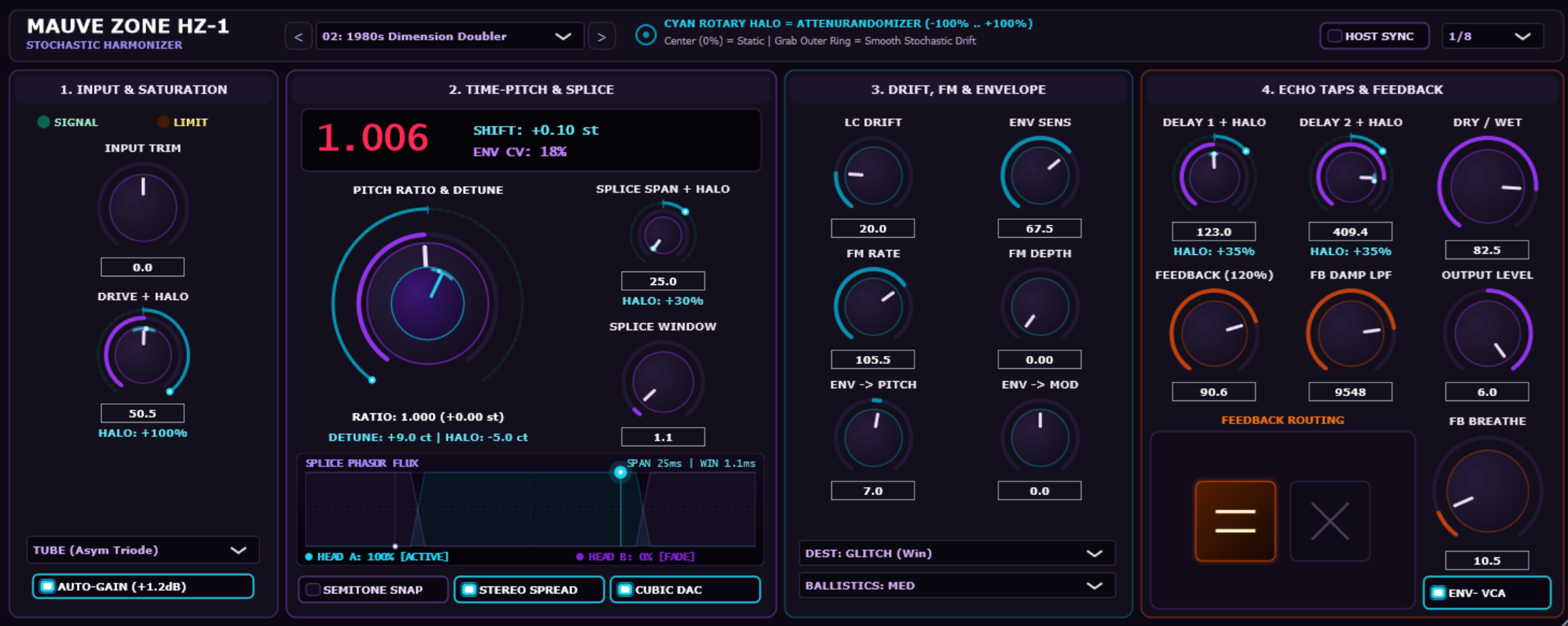
User's Manual & Reference
01 // Overview
The Mauve Zone Harmonizer HZ-1 is a dual-channel stereo pitch-shifting time processor, analog saturator, and recursive delay tank.
Drawing on mid-1970s hardware harmonizers such as the Eventide H910, it pairs circular-buffer pitch shifting with controllable splice crossfading, overdriven input saturation, runaway feedback regeneration, and continuous stochastic clock drift.
02 // Core Concepts
Time-Domain Pitch Shifting
Incoming audio writes continuously into a circular memory buffer while electronic read heads scan through that buffer at a speed set by your pitch ratio:
- Shifting Pitch Up: Read heads scan faster than the write head, periodically catching up and jumping backward to an earlier offset in the buffer.
- Shifting Pitch Down: Read heads scan slower than the write head, falling behind until reaching the buffer limit and jumping forward.
- Unison (Ratio 1.000): Write and read speeds match; delay stays fixed and no splicing occurs.
The Splice Glitch
Each buffer jump is a splice. In 1970s hardware, abrupt jumps created audible clicks and granular flutter. HZ-1 puts both ends of that behavior under direct front-panel control:
- Splice Span (25 ms – 150 ms): Sets grain cycle length between head jumps. Short spans produce metallic, granular buzz; longer spans keep pitch shifts smooth.
- Splice Window (0 ms – 25 ms): Sets the raised-cosine crossfade between anti-phase read heads (Head A and Head B). At 0 ms you get raw knife-edge clicks; higher settings produce seamless crossfades.
Stochastic Drift
Rather than using harsh uniform random jitter, HZ-1 models continuous thermal and mechanical drift with momentum and mean reversion:
- LC Master Clock Drift: Simulates thermal and voltage wander in an analog oscillator circuit.
- Thermal Component Mismatch: Left and right channels drift independently, widening the stereo field without phase collapse.
- Barkhausen Tape Hysteresis: Tape mode models magnetic domain hysteresis for natural transient rounding and harmonic cohesion.
Attenurandomizer Halos
Inspired by Mutable Instruments' control ergonomics, key parameters feature an outer cyan Attenurandomizer Halo:
- Center Pointer: Remains locked to your dialed base parameter value.
- Halo Excursion Arc: Turning the outer cyan ring opens a bounded excursion range around the base value, with a live indicator bead tracking the instantaneous stochastic offset.
03 // Signal Architecture
Signal flows left to right across four processing stages:
[INPUT AUDIO]
      │
      ▼
┌────────────────────────────────────────────────────────┐
│ 1. INPUT & SATURATION                                  │
│   • Clean Input Trim (-12dB .. +12dB)                  │
│   • Feedback Loop Summer Node                          │
│   • Saturation Engine (Op-Amp / Tube / Tape)           │
│   • Automatic Gain Compensation                        │
│   • 25 Hz Subsonic DC/Rumble Protection Filter         │
│   • Post-Saturation Envelope Follower (Sens / Speed)   │
└──────────────────────────┬─────────────────────────────┘
                           │
                           ▼
┌────────────────────────────────────────────────────────┐
│ 2. TIME-PITCH & SPLICE CORE                            │
│   • Dual Anti-Phase Read Heads (Head A & Head B)       │
│   • Concentric Pitch Control (Coarse / Fine / Halo)    │
│   • Splice Span & Crossfade Window                     │
│   • Semitone Quantization Snap                         │
│   • Stereo Detune Spread (Classic 1980s L/R Width)     │
│   • Converter Character (1975 Linear vs Modern Cubic)  │
│   • Dual-Head Splice Phosphor Visualizer Scope (CRT)   │
└──────────────────────────┬─────────────────────────────┘
                           │
                           ▼
┌────────────────────────────────────────────────────────┐
│ 3. DRIFT, FM & ENVELOPE MODULATION                     │
│   • LC Master Clock Stochastic Drift                   │
│   • Anti-Feedback Vibrato FM (20Hz - 200Hz)            │
│   • Dynamic Envelope to Pitch (Touch Pitch-Dive)       │
│   • Dynamic Envelope to Mod Send (Glitch/Filter/Duck)  │
└──────────────────────────┬─────────────────────────────┘
                           │
                           ▼
┌────────────────────────────────────────────────────────┐
│ 4. ECHO TAPS, FEEDBACK MATRIX & MASTER OUTPUT          │
│   • Dual Independent Stereo Delay Taps (Tap 1 & Tap 2) │
│   • Runaway Feedback Regeneration (Up to 120%)         │
│   • High-Frequency Analog Damping Filter               │
│   • Routing Matrix (Parallel '=' vs Ping-Pong 'X')     │
│   • Dynamic Breathing Feedback VCA (ENV- VCA)          │
│   • Master Output Level (Symmetrical ±6dB Unity Trim)  │
│   • Analog Soft-Knee Output Limiting Ceiling           │
└──────────────────────────┬─────────────────────────────┘
                           │
                           ▼
                     [OUTPUT AUDIO]
Panel 1: Input & Saturation Stage
- Clean Input Trim: Pre-tank gain (
-12 dBto+12 dB) sitting outside the feedback loop so tracking levels don't unbalance feedback repeats. - Tank Summer: Sums dry input with returning feedback audio.
-
Multi-Flavor Saturation:
- OP-AMP (75 Solid): Hard, punchy 1970s solid-state op-amp and silicon diode clipping.
- TUBE (Asym Triode): Warm, asymmetric even-order harmonics modeled on an overdriven triode preamp.
- TAPE (Barkhausen): Magnetic domain hysteresis with soft transient rounding and gentle top-end rolloff.
- Auto-Gain: Compensates level rise as
DRIVEincreases, adding a +1.2 dB push near maximum drive. - 25 Hz Subsonic Filter: Second-order in-tank high-pass filter preventing DC buildup and sub-bass mud during octave-down shifts.
-
Optical Metering:
- SIGNAL (Green): Lights at -40 dBFS to confirm incoming signal.
- LIMIT (Amber): Indicates peaks reaching the output ceiling.
Panel 2: Time-Pitch & Splice Core
- Dual-Head Tape Splice Engine: Read heads A and B alternate 180° out of phase inside the circular buffer so one head carries audio while the other resets.
-
Concentric Pitch Assembly:
- Outer Donut Wheel: Coarse pitch ratio from
0.500(-1 octave) to2.000(+1 octave); 12 o'clock is unison (1.000). - Inner Center Cap: Fine detune of ±50.0 cents in 1-cent steps.
- Outer Halo: Stochastic fine-detune attenurandomizer.
- Outer Donut Wheel: Coarse pitch ratio from
-
Splice Span & Window:
- Span (25 ms – 150 ms): Grain duration between head resets.
- Window (0 ms – 25 ms): Raised-cosine crossfade time between Head A and Head B.
- Semitone Snap: Quantizes coarse pitch ratio to chromatic semitones (+1 st, +5 st, +7 st, +12 st, etc.).
- Stereo Detune Spread: Inverts fine detune between channels (Left +Δ cents, Right -Δ cents) for wide 1980s-style stereo doubling.
-
DAC Character (Linear vs. Cubic):
- Linear (1975 DAC): Raw linear interpolation matching vintage 12-bit converter grit.
- Cubic (Modern): Polynomial cubic interpolation for clean shifting.
- Dual-Head Splice Scope: Live CRT scope showing Head A/B positions and crossfade envelope slopes.
Panel 3: Drift, Anti-Feedback FM & Envelope Tracking
- LC Clock Drift: Adds slow analog oscillator wander across pitch and delay heads.
- Anti-Feedback FM: Audio-rate vibrato oscillator (
20 Hz–200 Hz) that breaks up stationary feedback whistles into diffused sidebands. -
Envelope Follower:
- ENV SENS & BALLISTICS: Adjusts input sensitivity and detector speed (
SLOW,MED,FAST). - ENV -> PITCH: Routes playing dynamics to bend pitch upward or dive downward on note attacks.
- ENV -> MOD: Routes dynamics to
GLITCH (Win)(shrinks crossfade window on peaks),FILTER (LPF)(opens feedback damping), orWET DUCK(ducks wet signal during dry notes).
- ENV SENS & BALLISTICS: Adjusts input sensitivity and detector speed (
Panel 4: Echo Taps, Feedback Matrix & Output
- Dual Delay Taps: Tap 1 (
0 ms–250 ms) for slapback/thickening and Tap 2 (0 ms–500 ms) for longer echoes. - Runaway Feedback (0% – 120%): Values above 100% self-oscillate into soft-clamped analog saturation.
- High-Frequency Damping (1000 Hz – 18000 Hz): In-loop low-pass filter rolling off treble on successive repeats.
- Stereo Routing Matrix (
=vsX):=keeps channels parallel;Xcross-feeds Left and Right for ping-pong delays. - Dynamic Breathing Feedback VCA (
ENV- VCA): Ducks runaway feedback while you play and swells it back up in the pauses. - Master Output Level & Soft-Knee Ceiling: ±6.0 dB symmetrical trim around 0.0 dB unity gain, protected by an analog soft-knee limiter.
04 // Front Panel Layout
┌────────────────────────────────────────────────────────────────────────────────────────┐
│ [ < ] [ PRESET SELECTION BOX ] [ > ]               [ HOST SYNC ] [ 1/8 ]               │
├──────────────────┬───────────────────────────┬───────────────────┬─────────────────────┤
│ 1. INPUT & SAT   │ 2. TIME-PITCH & SPLICE    │ 3. MOD & DRIFT    │ 4. ECHO & FEEDBACK  │
│                  │                           │                   │                     │
│  [INPUT TRIM]    │  RATIO: 1.059 (+1.00st)   │  [LC DRIFT]       │  [DELAY 1] [DELAY 2]│
│                  │   DETUNE: +9.0c  HALO: 0c │  [ENV SENS]       │  [DRY/WET]          │
│  [DRIVE + HALO]  │  ┌─────────────────────┐  │                   │                     │
│                  │  │ (•) CONCENTRIC PITCH│  │  [FM RATE]        │  [FEEDBACK]         │
│  [FLAVOR BOX]    │  └─────────────────────┘  │  [FM DEPTH]       │  [FB DAMP]          │
│                  │  [SPLICE SPAN] [WINDOW]   │                   │  [OUTPUT LEVEL]     │
│  [AUTO-GAIN]     │  ┌─────────────────────┐  │  [ENV->PITCH]     │                     │
│                  │  │ CRT PHASOR SCOPE    │  │  [ENV->MOD]       │  [ = ]   [FB BREATHE│
│  (•)SIGNAL       │  └─────────────────────┘  │                   │  [ X ]       KNOB   │
│  (•)LIMIT        │  [SNAP] [SPREAD] [DAC]    │  [DEST] [SPEED]   │  ROUTING [ENV- VCA] │
└──────────────────┴───────────────────────────┴───────────────────┴─────────────────────┘
Concentric Pitch Assembly
- Middle Donut Wheel (Pitch Ratio): Drag for coarse ratio (
0.500to2.000). - Inner Center Cap (Fine Detune): Drag for ±50.0 cents precision detuning.
- Outer Cyan Halo Ring (Attenurandomizer): Adds bounded stochastic detune drift around the setpoint.
- Telemetry Readouts: Displays active pitch ratio, semitone interval, cents offset, and halo range.
Attenurandomizer Halos
Available on DRIVE, FINE DETUNE, SPLICE SPAN, DELAY 1, and DELAY 2:
- Center Pointer: Locked on your dialed base value.
- Cyan Excursion Arc: Shows the outer boundary of random wander.
- Stochastic Bead: Tracks live parameter drift in real time.
Dual-Head Splice Scope
┌─────────────────────────────────────────────────────────────┐
│ SPLICE PHASOR FLUX                     SPAN 75ms | WIN 12ms │
│ ─────────────────────────────────────────────────────────── │
│        |                                   |                │
│        |        (A)                        |       (B)      │
│        |         ▲                         |        ▲       │
│        |        / \                        |       / \      │
│ ───────┼───────/───\───────────────────────┼──────/───\──── │
│        |      /     \                      |     /     \    │
│        |     /       \                     |    /       \   │
│ ─────────────────────────────────────────────────────────── │
│ (•) HEAD A: 92% [ACTIVE]             (•) HEAD B: 8% [FADE]  │
└─────────────────────────────────────────────────────────────┘- Cyan Head A & Mauve Head B: Display real-time anti-phase buffer positions and crossfade weighting.
- Crossfade Envelope Silhouettes: Reflect live
SPLICE WINDOWwidth from sharp clicks to wide smooth slopes. - HUD Telemetry: Shows active grain span (ms), crossfade window (ms), and per-head level readouts.
Feedback Routing Switches (= and X)
- Parallel (
=): Keeps Left and Right feedback paths independent. - Cross (
X): Cross-couples Left into Right and Right into Left for ping-pong regeneration.
05 // Parameter Reference
Section 1: Input & Saturation Stage
| Parameter | Range | Default | Function |
|---|---|---|---|
| INPUT TRIM | -12.0 dB to +12.0 dB | 0.0 dB | Pre-tank input gain decoupled from the feedback loop. |
| DRIVE | 0.0% to 100.0% | 0.0% | In-tank analog saturation intensity. |
| DRIVE HALO | -100% to +100% | 0% | Stochastic drift depth for Drive. |
| FLAVOR | OP-AMP / TUBE / TAPE | OP-AMP | Op-Amp (hard solid-state), Tube (asymmetric triode), or Tape (Barkhausen hysteresis). |
| AUTO-GAIN | Off / On | On | Compensates level as Drive increases (+1.2 dB analog push at max). |
Section 2: Time-Pitch & Splice Core
| Parameter | Range | Default | Function |
|---|---|---|---|
| PITCH RATIO | 0.500 to 2.000 | 1.000 | Coarse pitch ratio (-1 octave to +1 octave). |
| FINE DETUNE | -50.0 ct to +50.0 ct | 0.0 ct | Cents detuning for micro-pitch doubling and chorusing. |
| DETUNE HALO | -100% to +100% | 0% | Stochastic detune wander (±5 cents range around setpoint). |
| SPLICE SPAN | 25 ms to 150 ms | 75 ms | Grain length between head resets. |
| SPAN HALO | -100% to +100% | 0% | Timing jitter applied to grain splices to reduce resonant ringing. |
| SPLICE WINDOW | 0.0 ms to 25.0 ms | 12.0 ms | Crossfade duration between Head A and Head B (0 ms = hard click). |
| SEMITONE SNAP | Off / On | Off | Quantizes coarse pitch ratio to chromatic semitones. |
| STEREO SPREAD | Off / On | On | Inverts fine detune across Left (+Δ) and Right (-Δ) channels. |
| CUBIC DAC | Off / On | On | Off = 1975 linear converter interpolation; On = smooth cubic interpolation. |
Section 3: Drift, FM & Envelope Modulation
| Parameter | Range | Default | Function |
|---|---|---|---|
| LC DRIFT | 0.0% to 100.0% | 10.0% | Analog clock instability causing pitch heads to wander slowly. |
| FM RATE | 20 Hz to 200 Hz | 40 Hz | Audio-rate anti-feedback vibrato frequency. |
| FM DEPTH | 0.0% to 100.0% | 0.0% | FM modulation depth; disperses feedback whistles or yields ring-mod textures. |
| ENV SENS | 0.0% to 100.0% | 50.0% | Input sensitivity of the envelope follower. |
| ENV SPEED | SLOW / MED / FAST | MED | Envelope attack/release ballistics. |
| ENV -> PITCH | -100% to +100% | 0.0% | Dynamic pitch bend depth driven by input envelope. |
| ENV -> MOD | -100% to +100% | 0.0% | Envelope modulation send to the selected target. |
| MOD DEST | GLITCH / FILTER / WET DUCK | GLITCH | Target for ENV -> MOD (Splice Window, Damping LPF, or Wet Ducking). |
Section 4: Echo Taps, Feedback Matrix & Master Output
| Parameter | Range | Default | Function |
|---|---|---|---|
| DELAY 1 | 0.0 ms to 250.0 ms | 35.0 ms | First stereo delay tap inside the feedback loop. |
| DELAY 1 HALO | -100% to +100% | 0% | Stochastic micro-timing drift on Tap 1. |
| DELAY 2 | 0.0 ms to 500.0 ms | 75.0 ms | Second delay tap for longer repeats. |
| DELAY 2 HALO | -100% to +100% | 0% | Stochastic drift on Tap 2. |
| FEEDBACK | 0.0% to 120.0% | 0.0% | Echo regeneration; above 100% enters soft-clamped self-oscillation. |
| FB DAMP | 1000 Hz to 18000 Hz | 8000 Hz | High-frequency damping low-pass filter inside the feedback tank. |
| ROUTING (= / X) | Parallel (=) / Cross (X) | Parallel | Parallel stereo channels vs cross-coupled ping-pong feedback. |
| FB BREATHE | 0.0% to 100.0% | 60.0% | Ducking depth applied when ENV- VCA is active. |
| ENV- VCA | Off / On | Off | Ducks recirculating feedback during dry note attacks. |
| DRY / WET | 0.0% to 100.0% | 50.0% | Constant-power dry/wet balance. |
| OUTPUT LEVEL | -6.0 dB to +6.0 dB | 0.0 dB | Master output trim (unity gain 0.0 dB at center). |
| HOST SYNC | Off / On | Off | Locks delay times to host DAW tempo. |
| SYNC SUBDIV | 1/32 to 1/1 | 1/8 | Rhythmic subdivision when Host Sync is engaged. |
06 // Sound Design Recipes
1. 1980s Micro-Pitch Stereo Doubler (Vocals, Guitars)
- Pitch Ratio:
1.000| Fine Detune:+9.0 ct| Stereo Spread:On - Delay 1 / 2:
28 ms/42 ms| Feedback:10% – 18%| FB Damp:10000 Hz - Splice Span / Window:
75 ms/18 ms| Drive:10%(Op-Amp) | Dry / Wet:35% – 45% - Tip: Add
+15%Detune Halo for slow stereo variation without static comb filtering.
2. Cascading Octave Shimmer (Pads, Ambient)
- Pitch Ratio:
2.000(+12 st) | Drive:25%(Tube) | Cubic DAC:On - Splice Span / Window:
90 ms/25 ms| Delay 1 / 2:120 ms/240 ms - Feedback:
72%| Routing:Cross (X)| FB Damp:5500 Hz| Dry / Wet:50%
3. Sub-Harmonic Reinforcement (Bass, Kicks)
- Pitch Ratio:
0.500(-12 st) | Semitone Snap:On| Drive:45%(Tube or Op-Amp) - Splice Span / Window:
110 ms/20 ms| Feedback:0%| Delay 1 & 2:0.0 ms| Dry / Wet:40%
4. Granular Splice Glitch (Drums, Percussion)
- Pitch Ratio:
1.414(+6 st) | Splice Span / Window:26 ms/0.0 ms| Cubic DAC:Off(Linear) - Drive:
55%(Op-Amp) | Delay 1 / 2:15 ms/30 ms| Feedback:45%| Dry / Wet:60% - Tip: Set
ENV -> MODto+80%,DEST: GLITCH (Win),ENV SPEED: FASTso drum hits clamp the window into sharp clicks.
5. Dynamic Pitch Dive (Guitars, Synths)
- Pitch Ratio:
1.000| ENV SENS:70%| ENV SPEED:FAST| ENV -> PITCH:-75% - Drive:
35%(Tube) | Delay 1 / 2:60 ms/120 ms| Feedback:30%| Dry / Wet:50%
6. Tape Warble & Drift (Keys, Guitars)
- Pitch Ratio:
0.944(-1 st) | LC Clock Drift:85%| Drive:35%(Tape) | Span Halo:+60% - FB Damp:
3200 Hz| Delay 1 / 2:80 ms/160 ms| Feedback:38%| Routing:Cross (X)
7. Self-Oscillating Ducking Tank (Drone, Experimental)
- Feedback:
106%| Routing:Cross (X)| Drive:30%(Tube) - FM Rate / Depth:
58 Hz/40%| ENV- VCA:On| FB Breathe:85%| ENV SPEED:MED
07 // Factory Presets (01–12)
┌────────────────────────────────────────────────────────────────────────┐
│ 01: Init (Default Clean)           07: Ethereal Fifth Harmony          │
│ 02: 1980s Dimension Doubler        08: Dynamic Touch Dive              │
│ 03: Cascading Octave Shimmer       09: Singing Runaway Cavern          │
│ 04: Sub-Harmonic Bass Titan        10: Cyberpunk Granular Glitch       │
│ 05: Lush Velvet Ensemble           11: Haunted Oscillator Siren        │
│ 06: Barkhausen Tape Tank           12: Ghostly Tape Float              │
└────────────────────────────────────────────────────────────────────────┘
01: Init (Default Clean)— Unity-gain baseline: ratio1.000, 0% drive, 0% feedback, Op-Amp path, 50/50 dry/wet.02: 1980s Dimension Doubler— +9.0 cents spread across stereo channels, 35 ms / 75 ms taps, 18% feedback, subtle LC drift.03: Cascading Octave Shimmer— +1 octave pitch loop at 68% Cross (X) feedback, Tube saturation, 25 ms splice window.04: Sub-Harmonic Bass Titan— -1 octave sub layer with Tube drive, auto-gain, and 4200 Hz damping.05: Lush Velvet Ensemble— Unison pitch with 100% Detune Halo, offset delay taps, and Tape drive.06: Barkhausen Tape Tank— 42% Tape saturation, 55 ms splice span, 5500 Hz damping for vintage echo tails.07: Ethereal Fifth Harmony— +7.0 semitone interval in 54% Cross (X) stereo ping-pong feedback.08: Dynamic Touch Dive— -100%ENV -> PITCHdownward attack bend that recovers on note decay.09: Singing Runaway Cavern— 102.5% self-oscillating feedback tamed byENV- VCAducking.10: Cyberpunk Granular Glitch— +6 semitone tritone, 26 ms span, 0 ms splice click, 1975 Linear DAC.11: Haunted Oscillator Siren— 106% Cross (X) feedback modulated by 58 Hz anti-feedback FM.12: Ghostly Tape Float— -1.0 semitone shift, 85% LC drift, 3200 Hz damping.
08 // DAW Workflow Notes
-
Insert vs. Aux Send:
- Insert: Keep
DRY / WETaround25%–50%. - Aux Send / Return: Set
DRY / WETto100%.
- Insert: Keep
- Keeping Lead Mixes Clear: Lower
FB DAMPto6000 Hz–8000 Hzwhen running feedback above 30% so echoes sit behind the dry signal. - Rhythmic Delays: Engage
HOST SYNCto lock Delay 1 and Delay 2 to DAW tempo subdivisions. - Key Automation Targets: Automate
PITCH RATIOwithSEMITONE SNAPenabled,FEEDBACKswells paired withENV- VCA, andSPLICE WINDOWdown to 0 ms on drum fills. - Gain Staging: Aim for
-12 dBFSto-6 dBFSat the input usingINPUT TRIMbefore driving saturation.
09 // Technical Specifications
- Product: Mauve Zone Harmonizer HZ-1 (
mzHarmonizer) - Website: mauve.zone
- Formats: VST3 (64-bit), Standalone Application (
.exe, 64-bit) - Framework: C++20 / JUCE 8
- Sample Rates: 44.1 kHz, 48.0 kHz, 88.2 kHz, 96.0 kHz, 176.4 kHz, 192.0 kHz
- DSP Architecture: Dual-mono waveshaping, stereo-linked envelope follower, pre-allocated circular buffer arena, FTZ/DAZ denormal protection
- GUI Resolution: Resizable vector UI (1020×500 min, 1280×580 default, up to 1920×960)
- OS Support: Windows 10, Windows 11 (64-bit)